Why Does ADHD Medication Sometimes Make Anxiety Worse?
For many adults with attention-deficit/hyperactivity disorder (ADHD), medication can significantly improve concentration, organization, and the ability to complete everyday tasks.
However, some individuals notice an unexpected change after starting ADHD medication: they feel more anxious, restless, or physically tense.
Others experience the opposite. Their anxiety improves once their ADHD symptoms are better controlled.
Why does this happen?
The relationship between ADHD, anxiety, and medication is complex. Understanding the possible causes can help patients and their psychiatric providers make informed treatment decisions.
Can ADHD Medication Cause Anxiety?
Yes. Certain ADHD medications, particularly stimulants, can cause or worsen anxiety-related symptoms in some individuals.
Common stimulant medications include:
- Adderall (mixed amphetamine salts)
- Vyvanse (lisdexamfetamine)
- Ritalin (methylphenidate)
- Concerta (extended-release methylphenidate)
These medications affect neurotransmitter signaling, particularly dopamine and norepinephrine, which play important roles in attention, motivation, and alertness.
Although these effects can improve ADHD symptoms, stimulants may also increase heart rate, blood pressure, or feelings of physical activation.
For some individuals, these sensations may be uncomfortable or resemble symptoms of anxiety.
Importantly, experiencing anxiety while taking a stimulant does not automatically mean the medication is inappropriate.
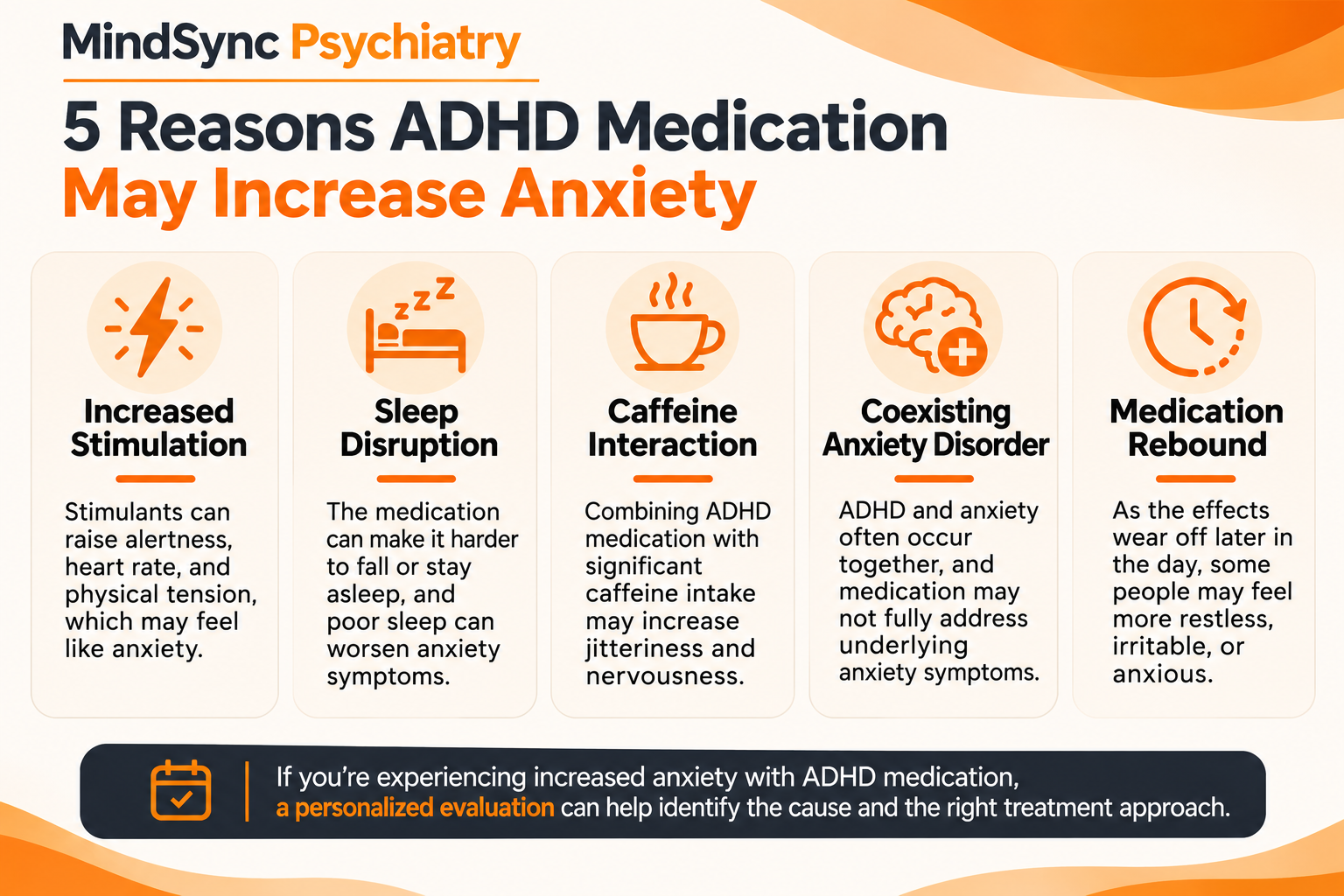
Five Reasons ADHD Medication May Make Anxiety Feel Worse
1. The medication may be producing excessive stimulation
Stimulants increase activity in neural systems involved in attention and alertness.
Some patients are particularly sensitive to these effects.
They may describe feeling:
- Jittery or restless
- More physically tense
- Unusually alert
- Irritable
- Unable to relax
- More aware of their heartbeat
These symptoms can occur even when concentration has improved.
A psychiatric provider may need to evaluate the medication’s dose, formulation, and overall tolerability.
2. The medication may interfere with sleep
Sleep disturbances are recognized adverse effects of stimulant medications.
Some individuals have difficulty falling asleep, particularly when a medication’s effects extend into the evening.
Insufficient sleep can worsen emotional regulation, concentration, and anxiety symptoms.
This can create a difficult cycle in which ADHD symptoms and anxiety become harder to manage.
When evaluating medication-related anxiety, it is important to ask whether sleep quality changed after treatment began.
3. Caffeine may be contributing to physical symptoms
Many adults consume coffee, energy drinks, or pre-workout supplements throughout the day.
Caffeine is another stimulant.
Combining substantial caffeine intake with prescription ADHD medication may increase jitteriness, restlessness, or sleep difficulties in susceptible individuals.
This does not mean everyone taking ADHD medication must completely avoid caffeine.
However, reviewing caffeine intake can be a useful part of assessing new or worsening anxiety symptoms.
4. The person may also have an anxiety disorder
ADHD and anxiety disorders can occur together.
For example, an adult may have ADHD alongside generalized anxiety disorder (GAD), which involves excessive and difficult-to-control worry.
ADHD treatment may improve attention and task completion without fully addressing persistent worrying, muscle tension, or other anxiety symptoms.
In these situations, a comprehensive evaluation can help determine whether anxiety requires additional treatment.
Having both ADHD and an anxiety disorder does not automatically rule out stimulant treatment. Medication decisions should consider the severity of each condition, treatment response, and tolerability.
5. Symptoms may change as medication effects wear off
Some patients describe becoming more irritable, restless, or emotionally uncomfortable later in the day as their medication’s effects diminish.
This is sometimes described clinically as rebound.
However, symptoms occurring in the afternoon or evening are not always caused by medication wearing off. Hunger, fatigue, inadequate sleep, and underlying anxiety may also contribute.
Tracking when symptoms occur in relation to medication administration can help a psychiatric provider identify patterns.
Can ADHD Medication Actually Improve Anxiety?
Yes, for some individuals.
Consider an adult who regularly misses deadlines, forgets appointments, struggles to organize responsibilities, and feels overwhelmed by unfinished tasks.
These difficulties can create substantial stress.
When ADHD treatment improves attention, organization, and task completion, the person may feel more capable of managing daily responsibilities.
As a result, some anxiety related to those difficulties may decrease.
However, this does not mean stimulant medications are treatments for generalized anxiety disorder.
Anxiety symptoms should be evaluated independently, especially when they persist despite improvements in ADHD.
How Can You Tell Whether Anxiety Is Related to ADHD Medication?
A psychiatric evaluation may explore several questions:
- Did the anxiety begin before or after starting medication?
- Did symptoms change after a dose adjustment?
- Does anxiety occur shortly after taking medication?
- Does it appear later in the day?
- Has sleep quality changed?
- How much caffeine is being consumed?
- Are there persistent worries unrelated to ADHD symptoms?
- Are there physical symptoms such as palpitations or dizziness?
The timing and nature of symptoms can provide useful information, but they do not establish the cause on their own.
Other medical conditions and medication effects may also need consideration.
What Can Help If ADHD Medication Increases Anxiety?
The appropriate approach depends on the individual’s symptoms, medical history, and response to treatment.
Reviewing the medication dose
A clinician may determine that a dose adjustment is appropriate if medication-related adverse effects outweigh the benefits.
Patients should not change prescribed doses without discussing the decision with their prescriber.
Evaluating a different stimulant formulation
Immediate-release and extended-release medications have different durations and patterns of drug exposure.
Some patients tolerate one formulation better than another.
A change in formulation may be considered when clinically appropriate, although it does not guarantee that anxiety symptoms will resolve.
Considering nonstimulant ADHD medications
Nonstimulant options may be appropriate for certain individuals.
Examples include atomoxetine (Strattera) and viloxazine extended-release (Qelbree).
These medications have different mechanisms and adverse-effect profiles from traditional stimulants.
They can also cause side effects and are not automatically free of anxiety-related concerns.
Medication selection should be individualized.
Treating a coexisting anxiety disorder
When ADHD and generalized anxiety disorder occur together, treatment may need to address both conditions.
Depending on the clinical presentation, treatment may include psychotherapy, medication for anxiety, or a combination of approaches.
Cognitive behavioral therapy (CBT) is an evidence-based psychotherapy that can help individuals recognize and modify patterns of thinking and behavior associated with anxiety.
Addressing sleep and daily habits
Consistent sleep, regular physical activity, appropriate nutrition, and reviewing caffeine consumption may help support treatment.
These strategies can complement psychiatric care but should not be presented as substitutes for indicated treatment.
When Should You Contact Your Psychiatric Provider?
Contact your prescriber if you notice new or worsening anxiety, persistent restlessness, insomnia, or other concerning symptoms after starting or adjusting ADHD medication.
Seek urgent medical attention for chest pain, fainting, severe shortness of breath, or other potentially serious symptoms.
The goal of ADHD treatment is not simply to improve concentration. Treatment should also support overall functioning, emotional well-being, and tolerability.
ADHD and Anxiety Treatment in New Jersey
At MindSync Psychiatry, William Chu, MSN, APRN, PMHNP-BC, provides psychiatric evaluations and medication management for individuals experiencing ADHD, anxiety, depression, and related conditions.
His clinical approach emphasizes individualized treatment, careful medication monitoring, and consideration of sleep, nutrition, and other lifestyle factors that may affect mental health.
If you are struggling with ADHD symptoms, anxiety, or medication-related concerns, a comprehensive psychiatric evaluation can help clarify your treatment options.
Schedule an appointment with MindSync Psychiatry.
Frequently Asked Questions
Does Adderall make anxiety worse?
Adderall can cause anxiety, nervousness, or agitation in some individuals. However, not everyone experiences these effects, and treatment response varies.
Can Vyvanse cause anxiety?
Yes. Anxiety and other activating symptoms can occur during treatment with Vyvanse. A prescriber can help assess whether symptoms are related to medication or another cause.
Is it possible to have both ADHD and generalized anxiety disorder?
Yes. ADHD and GAD can coexist. A comprehensive evaluation helps distinguish overlapping symptoms and guide treatment.
Are nonstimulant ADHD medications better for people with anxiety?
Not necessarily. Nonstimulants may be useful for some patients, but they are not universally preferable. Treatment depends on the individual’s diagnoses, history, response, and adverse effects.
Should I stop taking my ADHD medication if I feel anxious?
Do not independently change or discontinue prescribed medication without consulting your clinician, unless you are experiencing an emergency requiring immediate medical care.
Medical References
- National Institute of Mental Health. Mental Health Medications. https://www.nimh.nih.gov/health/topics/mental-health-medications
- U.S. National Library of Medicine, DailyMed. Adderall XR: Prescribing Information. https://dailymed.nlm.nih.gov/dailymed/drugInfo.cfm?setid=aff45863-ffe1-4d4f-8acf-c7081512a6c0
- National Institute for Health and Care Excellence (NICE). Attention Deficit Hyperactivity Disorder: Diagnosis and Management (NG87). https://www.nice.org.uk/guidance/ng87/chapter/Recommendations
Educational information only. This article does not replace individualized medical evaluation or treatment.
Clinical review: William Chu, MSN, APRN, PMHNP-BC — November 22, 2026.